Topic 1: Building and Construction Training Policy
Policy objectives
- Create employment and training opportunities for Queensland apprentices and trainees
- Support skills development in Queensland’s building and construction industry
- Enhance the economic independence of Aboriginal and Torres Strait Islander Queenslanders
Queensland Building and Construction Training Policy
Eligible projects
The Queensland Training Policy applies to eligible state‑funded building and civil construction projects across Queensland. It also extends to public/private partnerships where the Queensland Government provides funding support for project delivery.


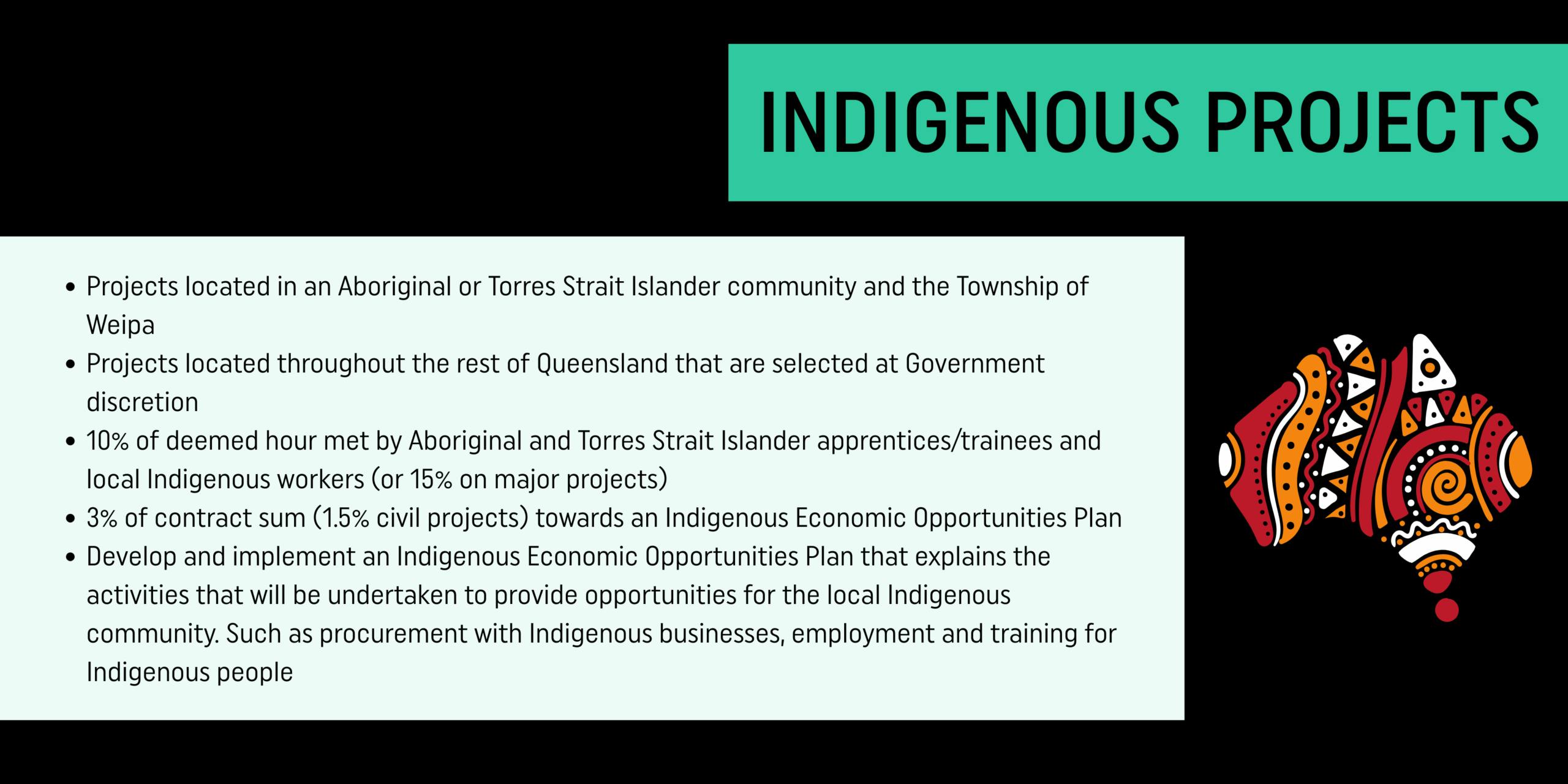
Indigenous project locations

Note. Source Appendix A from the Queensland Government Building and Construction Training Policy.
The Queensland Government provide further guidance on the process for Indigenous projects on their website.
Deemed hours calculations
Deemed hours calculations provide agencies with flexible methods to set training targets on Queensland Government projects. However, all methods require:
- 60% of the deemed hours are to be completed by new entrants (apprentices/trainees)
- 40% of the deemed hours are to be completed through other workforce training (upskilling existing workers)
Deemed hours method
-
- Building projects: contract sum × 0.06%
- Civil projects: contract sum × 0.03%
- Based on materials-to-labour ratios (70:30 for building, 85:15 for civil) and a nominal labour rate of $45/hour
10% method
- If total labour hours can be forecast, multiply by 10% to set the training requirement
Materials-to-labour ratio method
- Use project-specific materials-to-labour ratios to calculate hours
- Adjust for pay rates, GST, or design costs if needed
Other considerations
Agencies also consider:
- Public project commitments already made about employment and training
- Project specifics (timeframe, scope, skill levels required)
- Contractor’s commitment to improving industry skills and creating opportunities for apprentices, trainees and Indigenous workers
- Impacts on public-private partnerships or joint investment models
Key terms
Understanding the key terms in the Queensland Training Policy is essential for meeting its requirements. These definitions explain who qualifies as a new entrant, what counts as training hours and how labour contributions are measured. Together, they provide the foundation for knowing what the Policy expects and how compliance will be assessed.
New entrants
A new entrant is a person who:
- Is completing an apprenticeship or traineeship (combining study at a training organisation and learning on the job)
- Has not been employed by their current employer for more than three months before starting the apprenticeship
- Full list of Queensland apprenticeships and traineeships
- The only difference between an apprenticeship and traineeship is the funding model that supports them
Note: New entrant status is determined at the time a person signs up to their apprenticeship or traineeship.
- Once classified as a new entrant, they remain eligible throughout the duration of their apprenticeship or traineeship
- Apprentices in any year of their apprenticeship can be counted
- They do not need to be newly signed‑up first‑year apprentices
Other workforce training
Other workforce training recognises a broader range of activities that builds the skills and capability of the industry. These hours capture contributions from cadets, students and Indigenous workers engaged in training linked to the construction industry.
Labour hours
Labour hours recognise the contribution of workers who build skills through cadetships, higher education placements, or participation as Aboriginal and Torres Strait Islander workers.
- Cadets undertaking building and construction related qualification
- Students engaged in industry placement (Highschool, TAFE and University students)
- Aboriginal and Torres Strait Islander workers
- Apprentices and trainees that are not new entrant (employed for more than 3 months before commencing their apprenticeship)
Training hours
Training hours capture the time workers spend developing skills through formal study, vocational courses, or industry‑recognised upskilling. They include accredited qualifications as well as non‑accredited training delivered in‑house or by external providers, ensuring the workforce continues to grow capability across the construction industry.
- Vocational education and training (VET) courses directly linked to the workers role on the project
- Undergraduate or postgraduate degrees that support the construction industry
- Upskilling workers through short courses or non-accredited training sessions
- Upskilling workers through in-house training delivered by their company or a third party (cadet programs,
Example: A site supervisors is completing a Work Health and Safety Leadership short course delivered by an industry training provider. Although the course is non‑accredited, it is widely accepted across the sector as best practice and strengthens compliance with safety standards. The hours spent in this training can be counted as Other Workforce Hours.
Non-accredited
Non‑accredited training refers to courses, workshops, or short programs that do not lead to a formal qualification under the Australian Qualifications Framework. These sessions are still recognised by industry when they build practical skills, improve safety, or strengthen capability on construction projects.
Reporting
Reporting responsibilities are shared between head contractors and subcontractors, with each required to complete specific tasks to demonstrate compliance and track progress under the Queensland Training Policy.
The head contractor is required to:
- Upload completed training hours data to the online TPAS platform (monthly is preferred)
- Submit a Compliance Plan and Practical Completion Report
Subcontractors are required to:
- Meet the contract terms set out in the contract with the head contractor
- Report the completed training hours data to the head contractor monthly with your progress claim
Evidence
Evidence is required to verify apprentice and trainee participation, and it must clearly show who worked, when they worked, and how their hours contributed to the project’s compliance targets.
New entrants
- Onsite labour hours
- On or off site training hours
- Offsite labour hours
- Onsite labour hours completed by an apprentice who has been continuously employed by their employer for more than three months immediately prior to the commencement of their apprenticeship
- Timesheets
- Sign in sheet (handwritten okay)
- System generated report (payroll, labour costing, ect.)
- Subcontractor submissions (with evidence of source, e.g. payroll)
- Project name
- Employee details
- Dates worked
- Daily start and finish times
- Travel time cannot be included
- Leave cannot be included
- Multiple projects/sites on same timesheet
Other workforce
Labour hours
- Onsite labour hours and online training hours
- Training hours that is a requirement of the individual or subcontractor in order to effectively deliver the project
- Company or site inductions
- Toolbox talks
- Site meetings
- Timesheets
- Sign in sheet
- Site attendance register
- Project name
- Employee details
- Dates worked
- Daily start and finish times
- Hand written or electronic
Training hours
Onsite labour hours
Offsite labour hours
- Training plans/schedule
- Training record book
- Course enrolment record
- Course attendance records
- Certificate of attendance
- Learning Management System report
- Learning material (handbook, PowerPoints ect.)
- Employee details
- Training provider details
- Dates of training completed
- Start and finish times of training
This Evidence Guide sets out the minimum requirements for labour and training hours.
For further information, refer to the Training Policy compliance for other workforce training
Non-compliance
Non‑compliance with the Queensland Training Policy carries serious risks for both head contractors and subcontractors. Understanding these risks is essential to maintaining compliance and protecting long‑term contractual and business performance.
Risks
Non‑compliance creates different risks for head contractors and subcontractors. The sections below outline the specific consequences each party may face.
- Contract breach penalties – defined by contract but may include withholding security or retention and damages
- Accumulation of 20 demerit points will result in 12 month suspension from tendering QLD government projects
- Damage to reputational with both clients and community
- Jeopardise ability to win future contracts off previous performance
- Can trigger audits that can result in loss of time and could identify contract breaches
- Contract breach penalties – defined by contract but may include withholding security or retention and damages
- Damage to reputational with both clients and community
- Jeopardise ability to win future contracts off previous performance
Audits
Audits provide independent checks to confirm that contractors are meeting their training obligations. They verify reported hours and ensure outcomes are transparent and accountable.
- Completed by the Buy QLD Audit Unit
- Assess evidence for verification of TPAS hours submitted
- Verify outcomes in the IEOP
Project process
Keller follows a structured process to meet the Training Policy across every phase of a project. From tender through to project close‑out, each stage includes clear actions to ensure compliance, demonstrate workforce outcomes, and strengthen engagement with apprentices, trainees and priority groups.
Getting it right upfront
There is a suite of documents to provide detailed guidance on how to deliver each stage of the project effectively:
- Project Checklist
- FAQ & Troubleshooting Guide
The State Government also have guides to assist you to comply with the Policy:
- Frequently Asked Questions
- Guidelines for contractors
- Major Projects Guidelines – Skills Development Plan
- Guidelines for Indigenous Projects
- Indigenous Economic Opportunity Plan Template
- Variation Process

During the tender stage we need to demonstrate our capability and track record to secure the job. We review all documentation for references to the Queensland Government Building and Training Policy and identify how the head contractor expects us to contribute to the New Entrant and Other Workforce Training targets. Where targets are not achievable, we highlight these clearly and propose alternative ways we can add value.
1. Check if the Policy forms part of the tender documentation
- A key indicator is if the developer is a QLD government department (QBuild, Department of Public Works, QLD Health etc)
- Search (Ctrl F) the tender documents for key words such as apprentice hours, new entrant, Training Policy
2. Can we meet the contractual clauses asking us to contribute to apprentice targets?
- Liaise with the delivery team to assess our capability to deliver the required apprentice hours
- Identify risks and opportunities associated with contributing to these requirements using the Capability Assessment Template
NOTE: Keller avoids committing to apprentice and trainee targets in our contracts. Engineering and civil construction don’t have formal apprenticeship qualifications, so our scope of works falls outside this framework, and targets are not achievable. Instead, Keller invests in cadetships, delivering practical pathways into the industry, without over committing.
3. Showcase our previous performance for apprentices, workforce training and Indigenous employment and procurement
- Submit the Past Performance Template with the tender submission
4. Provide a written statement of how we can contribute to the head contractor’s training hours
- Complete the Social Procurement Commitments Template with project‑specific apprentice opportunities
- Flag any apprentice targets we cannot achieve and highlight any additional value we can provide. The Social Procurement Commitments Template has prompts to help identify risks and opportunities
- Submit the completed Social Procurement Commitments Template with the tender submission
- In some instances, the tender may require commitments to be written directly into Response Schedules. If this is the case, use the Social Procurement Commitments Template as guidance when drafting responses
5. Liaise with the head contractor throughout the tender phase to ensure clear understanding of training requirements
- Document any exclusions or negotiated amendments to the Training Policy requirements
Note:
Major projects – Also discuss how you can contribute to the head contractor’s Skills Development Plan in the Social Procurement Commitments Template. Liaise with their dedicated Training Coordinator throughout the tender phase and project delivery.
Indigenous projects – Provide a written statement of how you will contribute the head contractor’s Indigenous Economic Opportunity Plan
The contract stage is where tender commitments are formalised. It ensures that negotiated requirements are accurately captured, achievable obligations are confirmed, and any agreed value‑adds are included before project delivery begins.
1. Liaise with Tender team to ensure the contract reflects what was agreed during the tender phase
- If not, request for the contract to be updated to reflect what was negotiated during the tender
- Ensure any requirements we cannot achieve are not in the contract
- We recommend removing contract clauses committing to apprentice and trainee hours in our contracts. You can supplement this by offering to do additional Other Workforce Training hours or offering apprentice and trainee hours performed offsite. Refer to the Social Procurement Planning Guide for assistance in providing additional value.
2. Liaise with Project Delivery team to ensure those commitments can still be met and ensure any ways we can add value are in the contract
3. Document any exclusions or negotiated amendments
Note: The head contractor may apply for a variation to the deemed hours using the approved variation form. A variation will only be granted if the trades required to deliver the project scope do not have formal apprenticeship qualifications, or if the construction methodology is predominantly off‑site, such as modular construction.
The planning stage ensures that apprentice targets are embedded into project delivery from the outset. It sets clear responsibilities, establishes processes for compliance, and prepares the team to collect and report accurate data throughout the project lifecycle.
1. Nominate a project lead. This person will be responsible for:
- Conducting a handover with the Contract Negotiation team to understand the apprentice targets
- Ensuring the apprentice targets are met throughout the project
- Reporting project outcomes to the head contractor in monthly progress claims
2. Write a project plan to ensure smooth compliance throughout project delivery and clarify roles and responsibilities
- Complete the Project Plan Template outlining the New Entrant and Other Workforce targets, actions required to meet those targets, and reporting methodology
- Use the Social Procurement Planning Guide to identify sourcing channels for apprentices, trainees and upskilling opportunities
- The Project Plan is an internal working document used to assist the project team in delivering a compliant project. It is not shared with the head contractor or developer
3. Set up data collection folders and templates
- Use the Folder Structure Guide to implement the data collection process in preparation for the project delivery stage
4. Train the project team on the Policy and its requirements
- Give project staff access to this training module
The delivery stage is where plans are put into action. It focuses on meeting the targets, collecting accurate evidence and reporting progress. Strong delivery ensures compliance with the Training Policy and demonstrates tangible workforce outcomes.
1. Follow the Project Plan
- The project lead is responsible for ensuring the project team follows the Plan
- Deliver New Entrant and Other Workforce commitments as outlined in the Plan
2. Collect evidence
- Record apprentice and trainee labour hours and training hours completed using the Training Tracker and Social Procurement Tracker
- Include subcontractor contributions
3. Report progress
- Submit labour and training hours to the head contractor using the Monthly Progress Report Template
The close out stage captures the results of the project and ensures lessons are carried forward. It focuses on reporting achievements, documenting apprentice and participation outcomes, and refining processes so future projects can build on what has been learned.
1. Provide the head contractor with a final report to showcase project outcomes
- Use the Project Completion Report Template to summarise apprentice and training hours and compliance with targets
2. Draft a case study for use in future tenders
- Refer to the Case Study Template to highlight key achievements and demonstrate capability in meeting apprentice and training targets
3. Document achievements and lessons learned
- Use the Project Reflection Template to record successes, challenges and areas for improvement
4. Reflect and adjust
- Apply insights gained to strengthen apprentice participation strategies in upcoming projects
- Adjust any templates or processes to improve efficiencies on future projects