Topic 1: Social Procurement Framework
Policy objectives
The Victorian Social Procurement Framework makes sure government spending also delivers social and environmental benefits. When you work on these projects, you need to show how your business supports these goals:
- Create jobs and opportunities for Aboriginal people, people with disability, women, and priority jobseekers
- Buy from Aboriginal businesses, social enterprises, and suppliers who support fair and safe workplaces
Eligible projects
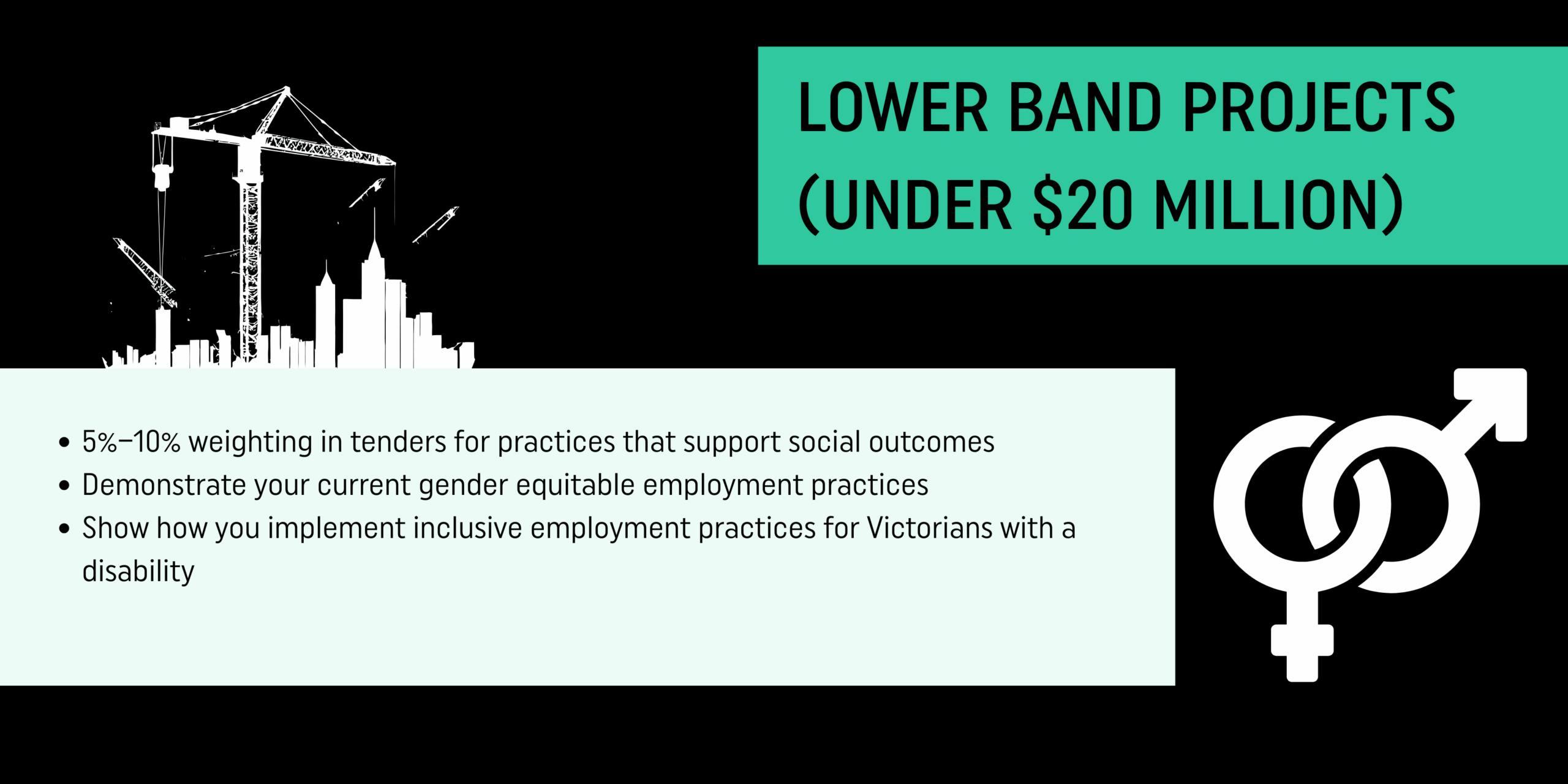
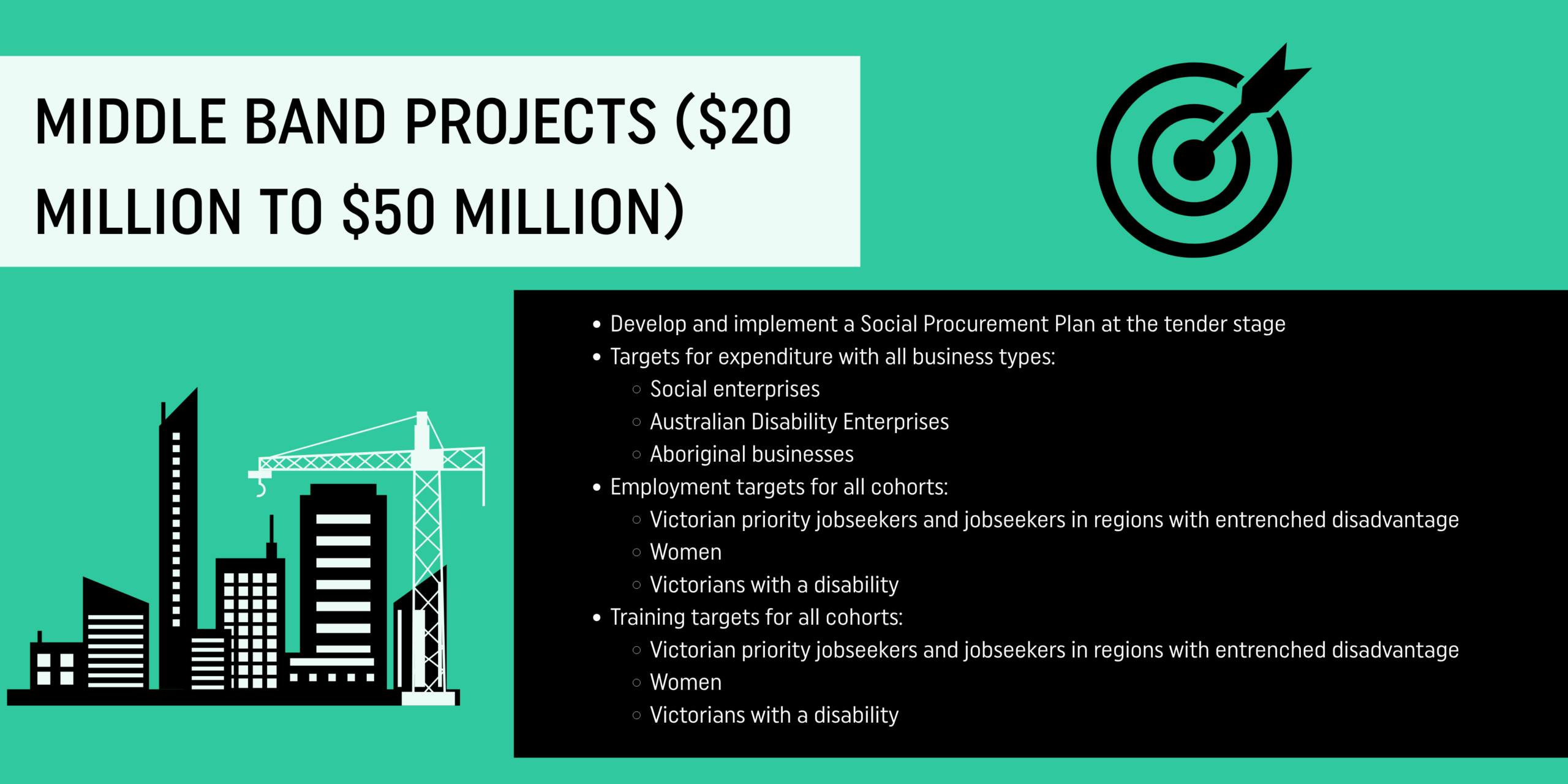
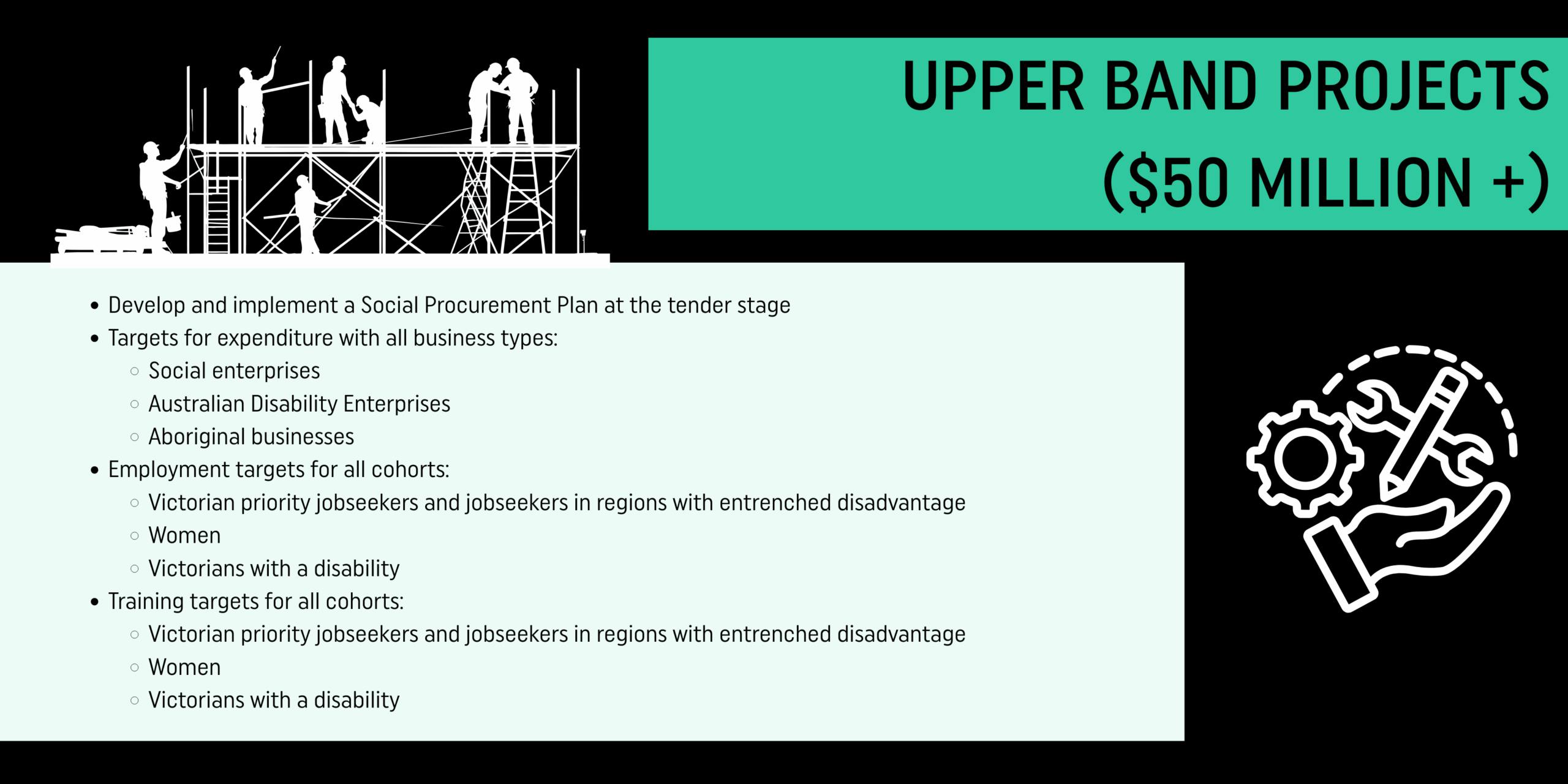
The framework applies to all Victorian Government procurement, with the requirements scaling with contract value. Bigger projects require stronger social procurement actions.
Target calculations
Each Departments analyses their projects and identify cohorts or business types who will benefit the most from the project. Then they allocate a suitable target to the cohort. There are no set percentages or dollar values under the Social Procurement Framework.
Note
On projects over $50 million, a target for all cohorts and business types is applied
Key terms
Understanding the key terms within the Social Procurement Framework is necessary for meeting its requirements.
Social procurement
- Buying in a way that intentionally delivers social benefits
Social enterprise / social benefit supplier
- Organisations whose primary purpose is social benefit (e.g. employing disadvantaged people)
Inclusion
- Give opportunities to socially disadvantaged people (e.g. long-term unemployed, people with disability, Aboriginal Victorians)
Diversity
- Promote racial, gender, and cultural diversity in workforce and suppliers
Local benefit
- Use local suppliers / social enterprises where possible
Social benefit outcomes
- The measurable improvements (e.g. number of people engaged, hours of training, local supplier spend)
Reporting
It is important to measure the costs and benefits of social procurement to ensure value for money is achieved and substantiated throughout the project. Reporting responsibilities are shared between head contractors and subcontractors.
The Head Contractor must:
- Measure outcomes and report them transparently to the client
- Performance will be reviewed and agencies publish social procurement annual reports
Subcontractors must:
- Comply with the social procurement requirements in their subcontracts
- Provide timely data to the head contractor (hours worked, business spend) so the head contractor can meet reporting obligations
Evidence
Evidence must verify labour and training hours for target groups and social procurement spend with Aboriginal -owned subcontractors, social enterprises, and disability enterprises.
Labour hours
Headcount and labour hours by people within each target group:
- Apprentices
- Learning workers
- People employed aged under 25
- Women in trades
- Women in non-traditional roles
- Aboriginal people
- Workers who live in the local region and are employed and being trained on the project
- Labour hours not linked to project delivery
- Travel to and from site
- Timesheets and payroll records
- Site attendance registers or sign in/out records
- Personal details – worker name, age, residential post code, gender, Aboriginal status, identify as having a disability
- Work information – employer, job title, Dates worked on site, start and finish times, apprentice/traineeship (yes/ no), type of apprenticeship/traineeship
Training hours
-
Onsite and offsite training hours completed by learning workers
- Training hours not linked or relative to project delivery
- Completion certificate
- Training attendance registers
- Course outline
- Personal details – worker name, age, residential post code, gender, Aboriginal status, identify as having a disability
- Work information – employer, job title, Dates worked on site, start and finish times
- Dates of training
- Start and finish times of training
- Training undertaken – current learning worker, type of training, training provider
Social procurement spend
- Procurement spend with Aboriginal -owned subcontractors and suppliers
- Procurement spend with Social enterprises
- Procurement spend with Disability enterprises
- Procurement spend with businesses not majority Aboriginal -owned, even if they employ Aboriginal staff
- Procurement spend with unverified claims of Aboriginal ownership (not certificated with Supply Nation or equivalent)
- Procurement spend with unverified claims of a Social enterprise (Not certified by Social Traders or equivalent)
- Copies of subcontract or supply agreements
- Invoices and payment records
- Supply Nation certification or equivalent
- Social Traders certification or equivalent
- Independent certification against the National Standards for Disability Services as legislated in the Disability Services Act (1986).
- Project name
- Business details, type and certifications
- Dates the services were provided
- Cost of services or supply provided
Non-compliance
Failure to comply with the Social Procurement Framework can create significant risks for head contractors and Keller. Understanding these risks is vital to protect compliance and long-term performance.
Risks
Consequences of non-compliance are detailed in the following section.
- Contract breach penalties – defined by contract but may include withholding security or retention and damages
- Damage to reputational with both clients and community
- Jeopardise ability to win future contracts off previous performance
- Can trigger audits that can result in loss of time and could identify contract breaches
- Contract breach penalties – defined by contract but may include withholding security or retention and damages
- Damage to reputational with both clients and community
- Jeopardise ability to win future contracts off previous performance
Project process
Keller follows a structured process to meet the requirements of the Social Procurement Framework across every phase of a project. From tender through to project close‑out, each stage includes clear actions to ensure compliance, demonstrate workforce outcomes, and strengthen engagement with apprentices, trainees and priority groups.
Getting it right upfront
There is a suite of documents to provide detailed guidance on how to deliver each stage of the project effectively:
- Project Checklist
- FAQ & Troubleshooting Guide
The State Government also have guides to assist you to comply with the Framework:
- Social procurement objectives, outcomes and focus areas
- Support for suppliers
- Planning for social procurement
- Responding to tenders

During the tender stage we need to demonstrate our capability and track record to secure the job. We review all documentation for references to the Social Procurement Framework and identify how the head contractor expects us to contribute to the head count, labour hours and training targets. Where targets are not achievable, we highlight these clearly and propose alternative ways we can add value.
1. Check if the Program forms part of the tender documentation
- A key indicator is if the developer is a VIC government department (eg. Development Victoria, Department of Health, Department of Transport and Planning etc)
- Search (Ctrl F) the tender documents for key words such as Aboriginal, apprentice, disability, gender
2. Can we meet the contractual clauses asking us to contribute to the targets?
- Liaise with the delivery team to assess our capability to deliver the social procurement requirements
- Identify risks and opportunities associated with contributing to these requirements using the Capability Assessment Template
NOTE: Keller avoids committing to apprentice and trainee targets in our contracts. Engineering and civil construction don’t have formal apprenticeship qualifications, so our scope of works falls outside this framework, and targets are not achievable. Instead, Keller invests in cadetships, delivering practical pathways into the industry, without over committing.
3. Showcase our previous performance for Aboriginal employment and procurement, female employment, apprentices and learning workers
- Submit the Past Performance Template with the tender submission
4. Provide a written statement of how you will contribute the head contractor’s employment and training hours
- Complete the Social Procurement Commitments Template with project‑specific opportunities or Aboriginal employment and procurement, female employment, apprentices and learning workers
- Flag any targets we cannot achieve and highlight any additional value we can provide. The Social Procurement Commitments Template has prompts to help identify risks and opportunities
- Submit the completed Social Procurement Commitments Template with the tender submission
- In some instances, the tender may require commitments to be written directly into Response Schedules. If this is the case, use the Social Procurement Commitments Template as guidance when drafting responses
5. Liaise with the head contractor throughout the tender phase to ensure clear understanding of the social procurement requirements
- Document any exclusions or negotiated amendments to the Social procurement Framework requirements
The contract stage is where tender commitments are formalised. It ensures that negotiated requirements are accurately captured, achievable obligations are confirmed, and any agreed value‑adds are included before project delivery begins.
1. Liaise with Tender team to ensure the contract reflects what was agreed during the tender phase
- If not, request for the contract to be updated to reflect what was negotiated during the tender
- Ensure any requirements we cannot achieve are not in the contract
- We recommend removing contract clauses committing to apprentice and trainee hours in our contracts. You can supplement this by offering to do additional upskilling hours. Refer to the Social Procurement Planning Guide for assistance in providing additional value.
2. Liaise with Project Delivery team to ensure those commitments can still be met and ensure any ways we can add value are in the contract
3. Document any exclusions or negotiated amendments
The planning stage ensures that the contractual targets are embedded into project delivery from the outset. It sets clear responsibilities, establishes processes for compliance, and prepares the team to collect and report accurate data throughout the project lifecycle.
1. Nominate a project lead. This person will be responsible for:
- Conducting a handover with the Contract Negotiation team to understand the targets
- Ensuring the contractual targets are met throughout the project
- Reporting project outcomes to the head contractor in monthly progress claims
2. Write a project plan to ensure smooth compliance throughout project delivery and clarify roles and responsibilities
- Complete the Project Plan Template outlining the Aboriginal employment and procurement, female employment, apprentices and learning workers, actions required to meet those targets, and reporting methodology
- Use the Social Procurement Planning Guide to identify sourcing to meet the requirements
- The Project Plan is an internal working document used to assist the project team in delivering a compliant project. It is not shared with the head contractor or developer
3. Set up data collection folders and templates
- Use the Folder Structure Guide to implement the data collection process in preparation for the project delivery stage
4. Train the project team on the Framework and its requirements
- Give project staff access to this training module
- You can learn more about social procurement objectives, outcomes and focus areas
The delivery stage is where plans are put into action. It focuses on meeting the targets, collecting accurate evidence and reporting progress. Strong delivery ensures compliance with the Framework and demonstrates tangible social procurement outcomes.
1. Follow the Project Plan
- The project lead is responsible for ensuring the project team follows the Plan
- Deliver employment, training and procurement commitments as outlined in the Plan
2. Collect evidence
- Record labour hours, procurement spend and training outcomes achieved using the Training Tracker and Social Procurement Tracker
- Include subcontractor contributions
3. Report progress
- Submit the Monthly Progress Report Template to the head contractor
The close out stage captures the results of the project and ensures lessons are carried forward. It focuses on reporting achievements, documenting training, workforce participation and procurement outcomes, and refining processes so future projects can build on what has been learned.
1. Provide the head contractor with a final report to showcase project outcomes
- Use the Project Completion Report Template to summarise compliance with social procurement targets
2. Draft a case study for use in future tenders
- Refer to the Case Study Template to highlight key achievements and demonstrate capability in meeting workforce participation, social procurement and training targets
3. Document achievements and lessons learned
- Use the Project Reflection Template to record successes, challenges and areas for improvement
4. Reflect and adjust
- Apply insights gained to strengthen workforce participation, social procurement and training strategies in upcoming projects
- Adjust any templates or processes to improve efficiencies on future projects