Topic 3: Building Equality Policy (BEP)
Policy objectives
- Increase the participation of women in the building, infrastructure, and civil construction sectors
- Create fairer, more inclusive workplaces
- Address gender imbalance by setting minimum workforce targets for women
Eligible projects
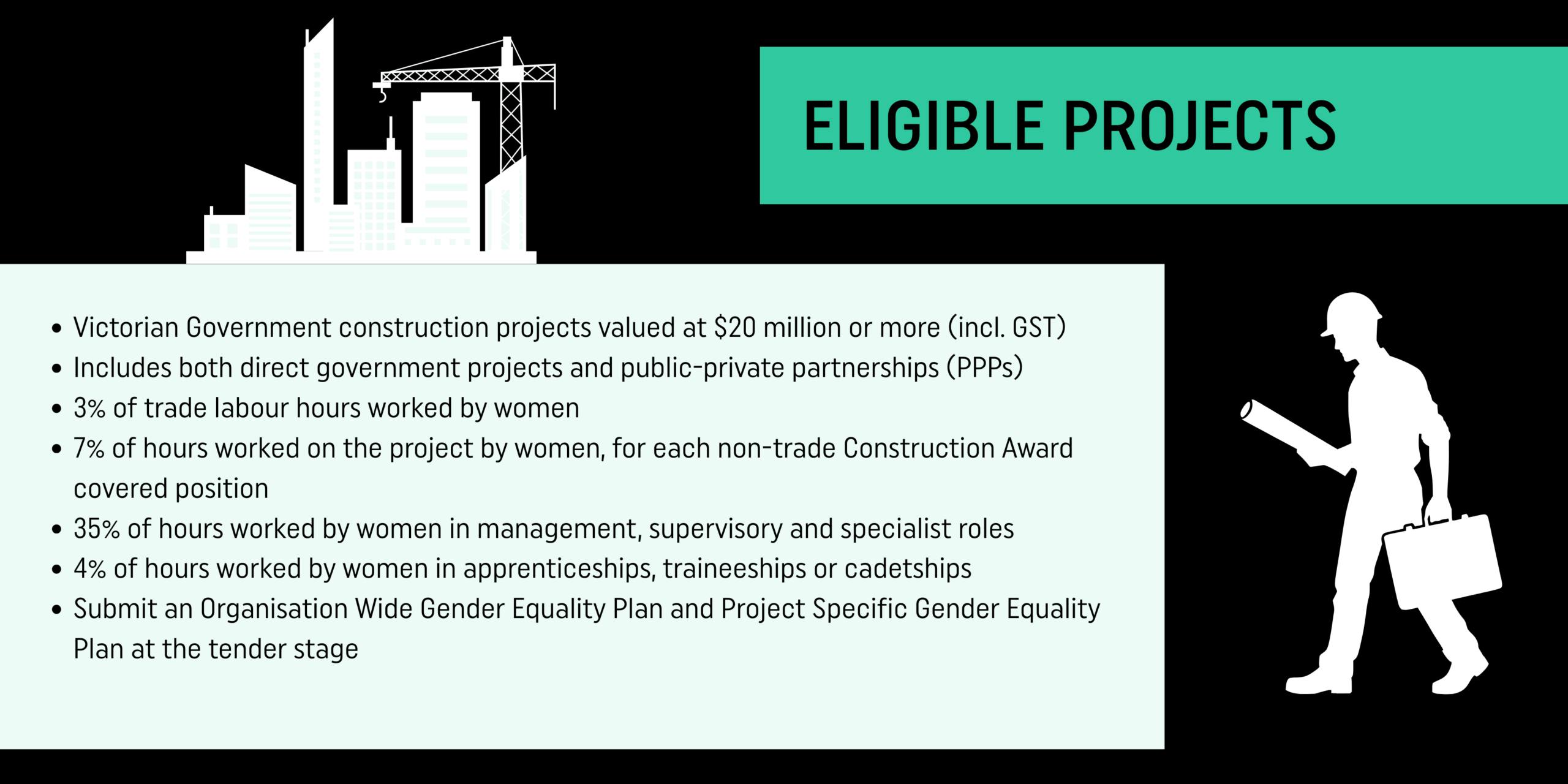
The Building Equality Policy applies to Victorian Government projects, including direct government projects and public-private partnerships, valued at $20 million or more.
Labour hours
The calculations show how many hours women must have completed in each labour category of a project. The results provide the standard number of hours women must complete to meet compliance with the Building Equality Policy.
To work out the percentage of labour hours completed by women in each category, use this formula:
% of women = (Number of hours worked by women in each category / total number of estimated hours to be worked in that category) x 100
Trade labour hours
- 3% of the total labour hours for each trade role must be completed by women
Example
- On Project XYZ, carpenters are expected to complete 10,000 labour hours
- To meet the BEP target, trade labour hours to be performed by women = 300 (10,000 x 3 / 100)
Non-trade Construction Award covered labour
- 7% of the total labour hours for each non-trade position must be completed by women
Example
- On Project XYZ, construction riggers are expected to complete 15,000 labour hours.
- To meet the BEP target, women must perform at least 1,050 hours (15,000 x 7 / 100)
- Keller’s monthly report:
- Hours worked by women riggers: = 20 hours
- Total rigger labour hours = 650 hours
- % women performing construction rigging = 3% (20 / 650) x 100
Management/supervisory and specialist labour
- 35% of the total labour hours for each management, supervisory or specialist position must be performed by women
Example
- On project XYZ, surveyors are expected to complete 7,000 labour hours.
- To meet BEP, women must perform at least 2,450 hours (7,000 x 35 / 100)
Apprentices, trainees, and cadets
- 4% of the total hours of work on the project must be performed by women
- Hours worked by women in these positions are calculated by using the total project labour hours and the formula specified in the Local Industry Development Plan
- Typically Annual Employee Equivalent or deemed hours
Key Terms
Understanding the key terms in the Building Equality Policy is essential for meeting its requirements. These definitions explain the general key terms mentioned throughout and provide the foundation for knowing of policy expectations and how compliance will be assessed. A full glossary is available on the website.
Apprentices, trainees, and cadets (ATCs)
Apprentices are generally:
- Undertaking a training contract with an employer that combines structured training with paid employment
- Completing a Certificate III level or above, for a duration of three to four years and are competency based
Cadets are typically:
- Undertaking entry-level role that combines formal tertiary training with paid practical work experience
- Enrolled in Australian tertiary education while undertaking work that is directly tied to their associated tertiary qualification
Trainees:
- Undertake entry-level roles under a training contract between an employer and a trainee that combines training with paid employment
- Undertake a Certificate II level or above qualification for approximately one to two years and are competency based
BEP
- Building Employment Policy, the policy that sets local employment targets for eligible construction projects
Gender Equality Action Plan (GEAP)
- A plan requiring contractors to gather data for each indicator and implement strategies to address the gender equality indicators under the Victorian Gender Equality Act 2020:
- Gender pay equity
- Gender composition of the workforce
- Gender composition of governing bodies
- Workplace sexual harassment
- Recruitment and promotion
- Gender work segregation
- Leave and flexibility
Labour hours
-
Total paid hours for all workers on the project
Non-trade Construction Award roles
- Trainees and supplementary workers engaged by the Contractor and subcontractors to perform work on the project
- Onsite roles not classified as trades
Trade roles
- Building and construction qualified trades and apprentices engaged by the Contractor or sub-contracted to perform work
- Includes carpentry, plumbing, electrical and other skilled construction roles
Victorian Management Centre (VMC)
- The body responsible for managing and reporting on BEP obligations, including monitoring compliance and supporting contractors in implementing their Gender Equality Action Plans
Reporting
Reporting responsibilities are shared between head contractors and subcontractors, with each required to complete specific tasks to demonstrate compliance and track progress.
The Head Contractor must:
- Submit a Project Specific Gender Equality Action Plan and an Organisation Wide Gender Equality Action Plan as part of the tender process
- Submit regular progress reports through the Victorian Management Centre (VMC)
- Reports must show actual labour hours worked by women against each target every six months
- Final completion reports confirm total hours and compliance
Subcontractors must:
- Contribute to the targets across the project
- Comply with any specific targets allocated to their subcontracts
- Provide data to the head contractor in their monthly progress report
Evidence
Evidence is required to verify trade labour hours both on-site and off-site. This evidence must also demonstrate the different labour contributions made by women, clearly showing who worked, when they worked, and how their hours contributed to the project’s compliance target.
Trade labour hours
- Onsite labour hours
- Offsite hours that are directly related to the project delivery
- Backoffice workers, managers and other professionals who are not onsite project-based workers
- Labour hours not linked to project delivers
- Travel to and from site
- Timesheets and payroll records
- Site attendance registers or sign in/out records
- Personal details – worker name and gender
- Work information – employer, job title, Dates worked on site, start and finish times
Women in management, supervisory and specialist roles
- Onsite labour hours
- Offsite hours that are directly related to the project delivery
- People that not spent 80% of their time dedicated to the specific project
- Backoffice workers, managers and other professionals who are not onsite project-based workers
- Labour hours not linked to project delivers
- Travel to and from site
- Timesheets and payroll records
- Site attendance registers or sign in/out records
- Personal details – worker name and gender
- Work information – employer, job title, Dates worked on site, start and finish times
Women in apprenticeships, traineeships or cadetships
- Onsite labour hours worked by women in apprenticeships, traineeships or cadetships
- Offsite hours that are directly related to the project delivery
- On or off site training hours
- Backoffice workers, managers and other professionals who are not onsite project-based workers
- Labour hours not linked to project delivers
- Travel to and from site
- Hours worked by male apprentices, trainees or cadets
- Timesheets and payroll records
- Site attendance registers or sign in/out records
- Course enrolment record
- Course attendance records
- Certificate of attendance
- Personal details – worker name and gender
- Work information – employer, job title, Dates worked on site, start and finish times, apprentice/traineeship (yes/ no), type of apprenticeship/traineeship
- Training provider details
- Dates of training completed
- Start and finish times of training
Women in non-trade construction award labour
- Onsite labour hours of women in non-trade related building works
- Offsite hours that are directly related to the project delivery
- Backoffice workers, managers and other professionals who are not onsite project-based workers
- Labour hours not linked to project delivers
- Travel to and from site
- Timesheets and payroll records
- Site attendance registers or sign in/out records
- Personal details – worker name and gender
- Work information – employer, job title, Dates worked on site, start and finish times
Non-compliance
Failure to comply with the Building Equality Policy can create significant risks for head contractors and Keller. Understanding these risks is vital to protect business and contractual performance.
- Managed using a staged approach
- If contractors are unable to meet the mandatory obligations, they may propose Alternative Appropriate Obligations for approval
Risks
The section below outlines the specific consequences the head contractor and Keller may face.
- Contract breach penalties – defined by contract but may include withholding security or retention and damages
- Reduced eligibility for future government projects
- Possible reputational damage for failing to meet gender equality requirements
- Can trigger audits that can result in loss of time and could identify contract breaches
- Contract breach penalties – defined by contract but may include withholding security or retention and damages
- Damage to reputational with both clients and community
- Jeopardise ability to win future contracts off previous performance
Project process
Keller follows a structured process to meet the requirements of the Building Equality Policy across every phase of a project. From tender through to project close‑out, each stage includes clear actions to ensure compliance, demonstrate outcomes for women, and strengthen engagement with apprentices, cadets and trainees.
Getting it right upfront
There is a suite of documents to provide detailed guidance on how to deliver each stage of the project effectively:
- Project Checklist
- FAQ & Troubleshooting Guide
The State Government also have guides to assist you to comply with the Policy:

During the tender stage we need to demonstrate our capability and track record to secure the job. We review all documentation for references to the Building Equality Policy and identify how the head contractor expects us to contribute to the gender equality targets. Where targets are not achievable, we highlight these clearly and propose alternative ways we can add value.
1. Check if the Program forms part of the tender documentation
- A key indicator is if the developer is a VIC government department (eg. Development Victoria, Department of Health, Department of Transport and Planning etc)
- Search (Ctrl F) the tender documents for key words such as women, BIP, gender
2. Can we meet the contractual clauses asking us to contribute to the targets?
- Liaise with the delivery team to assess our capability to deliver the gender equality requirements
- Identify risks and opportunities associated with contributing to these requirements using the Capability Assessment Template
NOTE: Keller avoids committing to apprentice and trainee targets in our contracts. Engineering and civil construction don’t have formal apprenticeship qualifications, so our scope of works falls outside this framework, and targets are not achievable. Instead, Keller invests in cadetships, delivering practical pathways into the industry, without over committing.
3. Showcase our previous performance for female employment and apprentices
- Submit the Past Performance Template with the tender submission
4. Provide a written statement of how you will contribute the head contractor’s female employment and training hours
- Complete the Social Procurement Commitments Template with project‑specific opportunities or women
- Flag any targets we cannot achieve and highlight any additional value we can provide. The Social Procurement Commitments Template has prompts to help identify risks and opportunities
- Submit the completed Social Procurement Commitments Template with the tender submission
- In some instances, the tender may require commitments to be written directly into Response Schedules. If this is the case, use the Social Procurement Commitments Template as guidance when drafting responses
5. Liaise with the head contractor throughout the tender phase to ensure clear understanding of the requirements
- Document any exclusions or negotiated amendments to the Building Equality Policy requirements
The contract stage is where tender commitments are formalised. It ensures that negotiated requirements are accurately captured, achievable obligations are confirmed, and any agreed value‑adds are included before project delivery begins.
1. Liaise with Tender team to ensure the contract reflects what was agreed during the tender phase
- If not, request for the contract to be updated to reflect what was negotiated during the tender
- Ensure any requirements we cannot achieve are not in the contract
- We recommend removing contract clauses committing to apprentice and trainee hours in our contracts. You can supplement this by offering to do additional upskilling hours. Refer to the Social Procurement Planning Guide for assistance in providing additional value.
2. Liaise with Project Delivery team to ensure those commitments can still be met and ensure any ways we can add value are in the contract
3. Document any exclusions or negotiated amendments
The planning stage ensures that the contractual targets are embedded into project delivery from the outset. It sets clear responsibilities, establishes processes for compliance, and prepares the team to collect and report accurate data throughout the project lifecycle.
1. Nominate a project lead. This person will be responsible for:
- Conducting a handover with the Contract Negotiation team to understand the targets
- Ensuring the contractual targets are met throughout the project
- Reporting project outcomes to the head contractor in monthly progress claims
2. Write a project plan to ensure smooth compliance throughout project delivery and clarify roles and responsibilities
- Complete the Project Plan Template outlining the actions required to meet the gender equality targets, and reporting methodology
- Use the Social Procurement Planning Guide to identify sourcing to meet the requirements
- The Project Plan is an internal working document used to assist the project team in delivering a compliant project. It is not shared with the head contractor or developer
3. Set up data collection folders and templates
- Use the Folder Structure Guide to implement the data collection process in preparation for the project delivery stage
4. Train the project team on the Policy and its requirements
- Give project staff access to this training module
- You can learn more about the BEP policy on the supplier page
The delivery stage is where plans are put into action. It focuses on meeting the targets, collecting accurate evidence and reporting progress. Strong delivery ensures compliance with the Policy and demonstrates tangible gender equality outcomes.
1. Follow the Project Plan
- The project lead is responsible for ensuring the project team follows the Plan
- Deliver gender equality commitments as outlined in the Plan
2. Collect evidence
- Record labour hours and training outcomes achieved using the Training Tracker and Social Procurement Tracker
- Include subcontractor contributions
3. Report progress
- Submit the Monthly Progress Report Template to the head contractor
- Provide the head contractor with a final report
- Document achievements
- Reflect and adjust