Adjudication Locally by Michael Chesterman
Adjudication: Born Out of Necessity
Opinion view of Helix Compliance Director Michael Chesterman
BCIPA 2004 was developed to provide a simple, accessible pathway for contractors to secure payment for work completed—a statutory option that delivered quick decisions without losing any contractual rights.
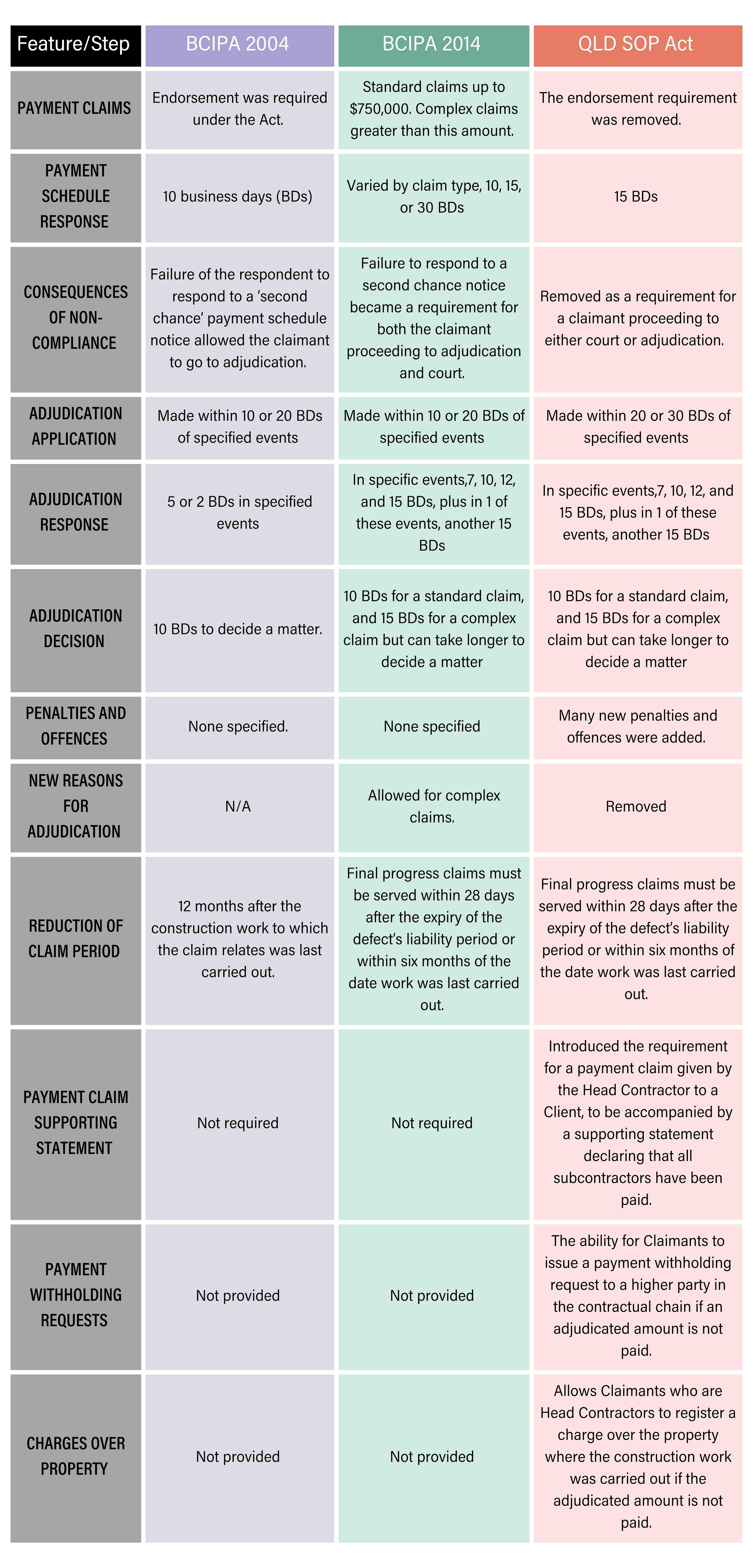
The key operational provisions of BCIPA 2004 laid out a straightforward framework for progress payments, payment schedules, and adjudication applications. The aim was always to keep it simple so that everyone involved could easily understand their rights and obligations. There were no penalties or offences—just a clear system to resolve disputes.
The simplicity of BCIPA 2004 was reflected in three core features:
- 10 Business Days for Payment Schedule: Respondents had 10 business days to serve a payment schedule after receiving a payment claim. If they failed to do so, claimants were required to issue a “Second Chance Notice”, giving respondents an additional five business days before escalating to court.
- 5 Business Days to Respond to Adjudication Application: Respondents could serve a response within five business days after receiving a copy of the adjudication application, or two days after notice of an adjudicator’s acceptance of the application.
- 10 Business Days for Adjudicator’s Decision: Adjudicators had 10 business days to decide a matter.
This “one size fits all” model worked effectively for a decade, providing clarity and accessibility for all parties. BCIPA 2004 remained unchanged for 10 years, and during that time, adjudication was widely used to resolve payment disputes.
The Turning Point: BCIPA 2014 and the QLD SOP Act
Things began to change in 2014, with significant amendments to BCIPA. These amendments introduced the concepts of Standard and Complex Payment Claims, effectively creating two categories based on the value of claims.
For complex claims, the 2014 BCIPA extended response periods, and allowed respondents to raise new defences during adjudication—adding complexity that was absent from BCIPA 2004.
This trend towards greater complexity continued with the introduction of the Building Industry Fairness (Security of Payment) Act 2017 (QLD SOP Act).
The QLD SOP Act reversed many of the 2014 amendments while adding a slew of new requirements:
- The endorsement requirement for payment claims was removed to make the process simpler, but new penalties and offences were introduced, adding more compliance burdens.
- Second Chance Notices were eliminated, and deadlines for payment schedules and adjudication applications were extended.
- The Act imposed restrictions on respondents, barring them from introducing new reasons for withholding payment during adjudication that were not included in the payment schedule.
- The QLD SOP Act also introduced entirely new mechanisms like Payment Withholding Requests and the ability for head contractors to register charges over the property if payment was not received.
While these reforms were designed to create a fairer system, the reality is that they added layers of complexity that made the adjudication process harder for contractors to navigate.
Fragmented Adjudication Timeframes: A Major Issue
One of the most significant challenges I’ve observed is the fragmented nature of adjudication timeframes across Australian jurisdictions.
During my time as Adjudication Registrar and even now, I have consistently seen how crucial time is in construction projects—it determines project success, impacts relationships, and affects financial outcomes. Yet, despite this importance, the fragmentation of adjudication time provisions across Australia has created substantial confusion and inefficiency.
Each state has its own adjudication legislation with differing timeframes for key steps such as payment claims, payment schedules, adjudication applications, and adjudication responses:
- Payment Claim Timeframes: These vary significantly, ranging from 3 months (VIC) to 12 months (NSW, ACT, TAS) after work completion. NT allows claims anytime after the contractor has fulfilled their obligations.
- Payment Schedule: Typically, this timeframe ranges from 10 to 20 business days, with variations based on the jurisdiction and the project type.
- Adjudication Application: The timeframes for filing an adjudication application can range from 10 to 30 business days, with further variations depending on conditions such as whether a payment schedule was provided.
- Adjudication Response: Timeframes for adjudication responses range from 5 to 15 business days, again varying by jurisdiction.
This lack of harmonisation means that contractors working across multiple states face different rules for the same adjudication process, adding significant administrative burdens and costs. It’s as if every jurisdiction decided to “do their own thing,” without considering the value of consistent, efficient time management—a principle that lies at the heart of successful construction project delivery.
Governments have inadvertently created a fragmented landscape, and the losers are the contractors who need to implement these disparate processes. As I have argued before, time considerations are fundamental to good construction management, and it’s baffling that these have been ignored when creating these adjudication regimes.
The perfect opportunity exists now for a renewed push towards harmonising adjudication timeframes. By focusing initially on the four key adjudication steps—payment claim, payment schedule, adjudication application, and adjudication response—we could bring much-needed uniformity and predictability across jurisdictions.
The concept is simple: crawl before you walk, walk before you run. If we can achieve this modest, yet significant harmonisation goal, we can quickly gather momentum for more extensive reforms.
The Decline in Adjudication Usage: Why It Matters
The decline in adjudication usage is well documented.
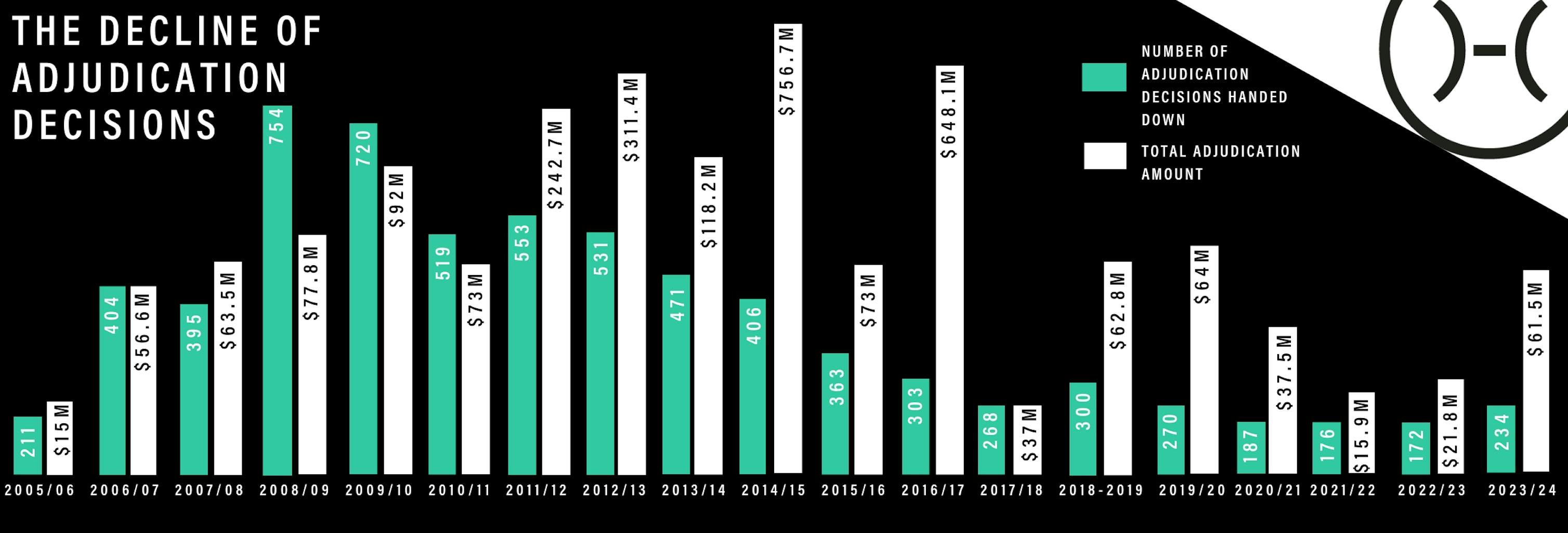
In the above infographic, we can see a sharp decrease in the number of adjudication decisions since a peak of 754 adjudication decisions in 2008/09.
By the time we reached 2023/24 under the QLD SOP Act, that number had fallen to 234 decisions—a staggering 69% decline over 14 years.
The complexity of the legislation is seemingly a major reason for this decline. The BIFA has been criticised for its strict validity requirements, making it difficult for industry participants to comply with the adjudication process.
This complexity is a deterrent, pushing contractors away from adjudication as an effective tool for securing payments.
Another factor is the loss of procedural support. While I remain an ardent supporter of this necessary integrity reform, with the QBCC assuming roles previously held by Authorised Nominating Authorities (ANAs), the industry lost a key layer of aid that made navigating adjudication easily accessible via multiple businesses.
The QBCC, through the Adjudication Registry, needs to improve their performance in this regard.
In this regard, I was pleased to note the following comment in the QBCC 2023/2024 Annual Report:
“The Registry continues to review all systems and processes to ensure maximum efficiency in meeting its statutory mandate. To enhance regional customer experiences, the Registry conducts annual training on the adjudication process and develops associated procedures with the QBCC regional team members across the State.”
There is now also an oversupply of adjudicators (130 as of 1 November 2024) competing for fewer matters.
Positive Developments: Collaboration and Defensive Strategies
However, it’s not all negative. There are also some positive reasons behind the decline in adjudication decisions. One of the main reasons is that parties are working harder to resolve disputes privately. With adjudication decisions being published publicly, there is a growing focus on protecting commercial reputations, and encouraging parties to reach settlements before resorting to adjudication.
The industry has also started to embrace collaborative contracting. The shift from adversarial positions towards shared risk and reward models is reducing the need for adjudication as parties work together to achieve common goals. While the data is no available to demonstrate this connection, it is my observation based on decades in the industry.
A Call for a Return to Simplicity and Harmonisation
The decline in adjudication decisions doesn’t necessarily mean adjudication is failing. If parties are increasingly resolving disputes through collaboration and contractual negotiation, that’s a positive development.
However, adjudication must remain a viable last-resort option—one that is accessible and straightforward.
We believe it’s time to review the QLD SOP Act with an eye towards simplification and co-operation towards harmonisation.
Call me biased if you like, but I think we need to bring back the simplicity that made BCIPA 2004 successful, while also ensuring that adjudication processes across Australia are consistent and predictable.
The process must be understandable, cost-effective, and fair for all parties involved. Contractors need to feel confident in using adjudication, when necessary, without getting lost in a maze of bureaucratic hurdles and without being burdened by differing state regulations.